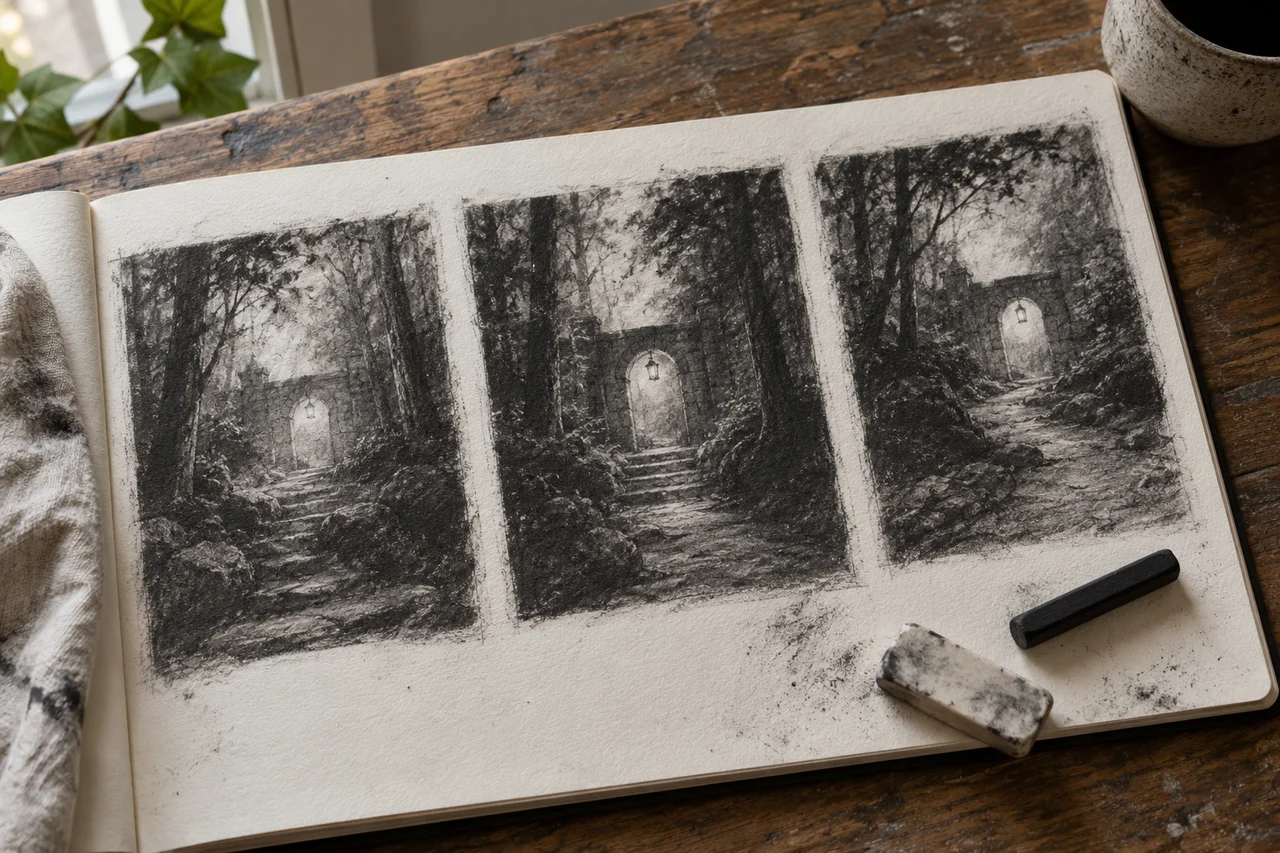
A detailed image can still be difficult to read. Before polishing textures, give the viewer a clear route through the composition. This exercise uses a small lantern beside a forest gate as the focal point. You can paint the study, block it in 3D or use an image model to explore alternatives. The goal is to judge the structure at a small size.
1. Work with three broad value groups
Make a dark foreground, a middle-value gate and a lighter patch around the lantern. Treat these as starting constraints for the exercise, rather than a rule for every artwork. Keep foliage within its larger value mass. A scattering of equally bright leaves can pull attention away from the main subject.
Dark group: foreground trunks and the outer frame.
Middle group: the gate, path and large foliage shapes.
Light group: the lantern and a small patch of mist.
A narrow forest path leading to an old stone gate, a small amber lantern beside the entrance as the focal point, dark foreground trunks framing the view, simple middle-value foliage, one pale mist shape behind the lantern, three clear value groups, broad environment concept-art shapes.2. Compare three tiny arrangements
Draw three thumbnails before choosing one. Put the lantern on the left, place it near the centre, then move it deeper along the path. Compare how the path, silhouettes and empty space support each arrangement. Spend a few minutes on each image; this stage should be quick enough that you can comfortably discard an option.
Tool check: Krita · Layers and Masks describes organising artwork into named layers and groups. In this exercise, separate the foreground frame, gate and mist so you can move those large shapes independently.
3. Use colour after the structure works
Try a cool green forest with a warm amber focal point. Temporarily inspect the image in greyscale to see whether the intended light area still stands apart. A colour pairing may be attractive while its values remain too similar. Adjust the larger masses before making the lantern brighter and brighter.
A quiet stone gate in a cool green forest, a single amber lantern beside the entrance, restrained green and charcoal palette, a small warm focal accent, broad foliage masses, clear dark-to-light separation around the lantern, soft mist with minimal texture.A simple review checklist
At a small size, can you find the lantern within a moment?
Does one background shape compete with the focal point?
Does the path lead attention toward the entrance?
Are the darkest areas grouped rather than scattered everywhere?
Does the colour version preserve the useful value relationships?
Try covering the bright focal accent with your finger. If the scene becomes difficult to understand, strengthen the supporting silhouettes and path before adding more surface detail.
Keep the three thumbnails beside the final study. They make your composition decisions visible and provide useful process material when you later publish the work.