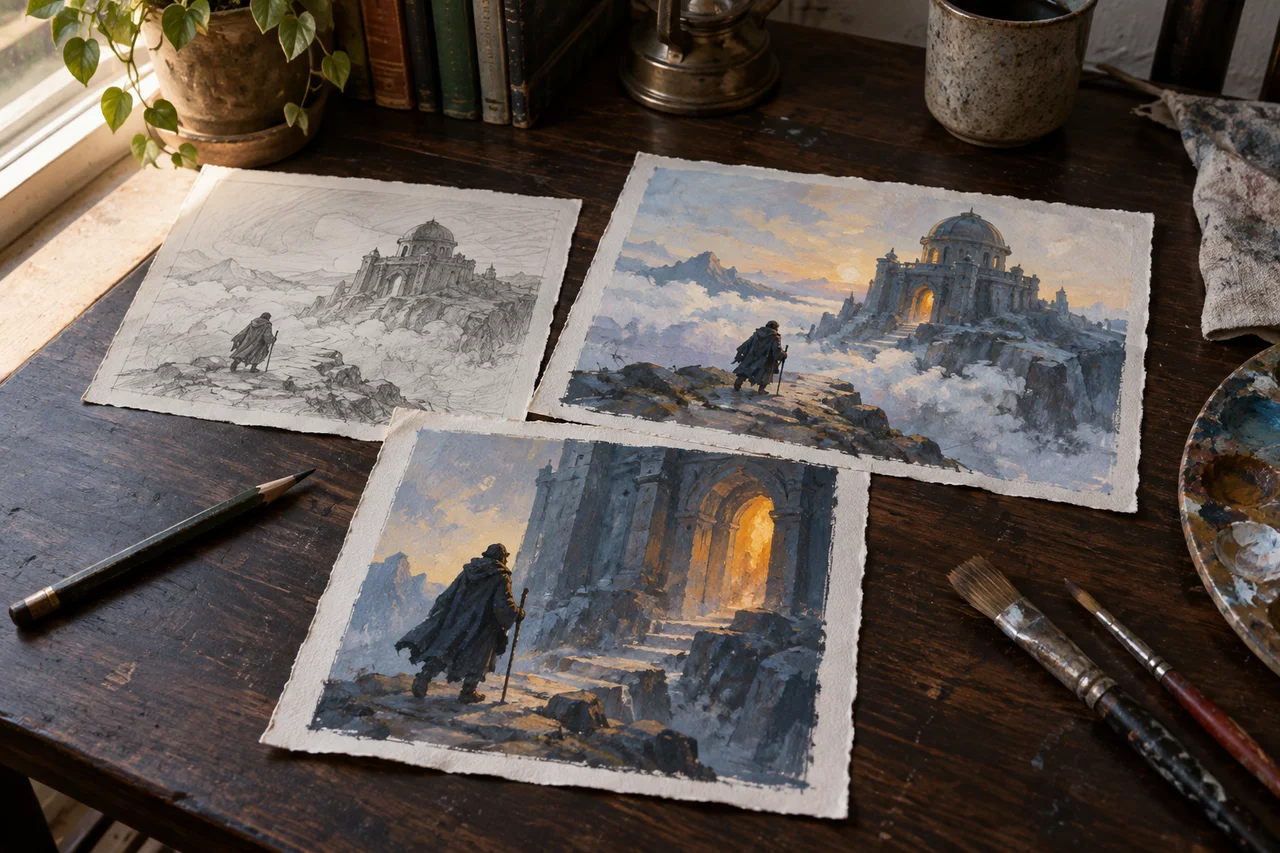
A useful image prompt gives you decisions to evaluate. When a result feels wrong, you should be able to point to the framing, the lighting or the materials and describe a change. This exercise turns an open-ended idea into a small visual brief. It works as a starting point across image tools, although each model will interpret the same words differently.
Your outcome: one clear brief, three controlled variations and a short note explaining which version works best.
1. Decide what the image has to communicate
Imagine a young explorer finding a quiet observatory above the clouds. The emotional goal is curiosity. Give the viewer one main subject and one discovery to notice. A storm, a crowd, a spaceship and several mythical creatures would compete with that goal. Sketch a sentence describing the moment before thinking about a long list of visual adjectives.
Subject: an explorer paused at the entrance.
Setting: a small observatory rising above clouds.
Framing: a wide view with space around the figure.
Light and palette: warm windows against a cool dawn.
Medium: a painterly environment illustration.
A lone explorer at the doorway of a small observatory above the clouds, wide environment composition, the figure placed in the lower-left third, warm amber window light against a cool blue dawn, broad painterly shapes, quiet curiosity.Tool check: Midjourney · Prompt Basics describes concise visual prompting and concrete choices such as subject, medium, lighting and composition. The examples here are original Artisio briefs, without tool-specific parameters.
2. Change one decision at a time
Keep the subject and setting while comparing two kinds of framing. Save the original prompt beside each result so you can see which instruction changed. Generate a small set before expanding the brief. If your tool exposes a seed, record it as a useful comparison aid; a seed alone does not guarantee identical results across models, settings or versions.
A lone explorer at the doorway of a small observatory above the clouds, close view from behind the explorer, doorway framing the bright cloud horizon, warm amber window light against a cool blue dawn, broad painterly shapes, quiet curiosity.3. Repair a specific weakness
Suppose the doorway gets lost in the first result. Ask for a clearer value separation and keep the successful lighting idea. Avoid adding unrelated objects to compensate for a weak focal point. You can also make a quick paint-over or reference sketch and use it in a tool that accepts composition references.
A lone explorer entering a cloud-top observatory, wide environment illustration, dark entrance silhouette surrounding a luminous amber doorway, cool blue cloud masses kept simple, a clear focal point at the threshold, broad painterly shapes and restrained detail.A ten-minute practice session
Spend two minutes defining the moment and focal point.
Compare the wide and close framing without changing the palette.
Judge readability at thumbnail size before inspecting texture.
Write one successful decision and one next change beneath each version.
Keep the strongest version even if it has unfinished details. A useful prompt notebook records decisions and their effects. It becomes much more helpful than an unlabelled folder of attractive outputs.