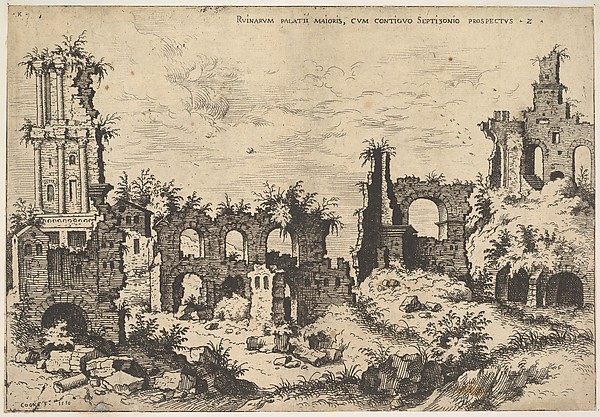

View of ruins on the Palatine Hill with trabeated facade at left and arcades at center, from "The Ruins of Rome" (Praecipua aliquot Romanae antiquitatis ruinarum monimenta, vivis prospectibus)
Hieronymus Cock · 1550 · Etching · Bequest of Phyllis Massar, 2011
16th-century fine line etching
Render with fine etched lines varying from delicate to sharply incised, subtle tonal plate shading, predominantly monochrome warm sepia to light grey palette, soft natural lighting with gentle shadows, and clear layered spatial composition with detailed atmospheric depth.
Render [your subject] using fine etched linework on paper with occasional plate tone for shading. Precise and clear lines varying from delicate to sharply incised contours. A monochrome range from warm sepia browns to soft greys with subtle tonal gradations. Even, soft natural lighting with gentle shadows defining volume. Layered spatial arrangement using atmospheric perspective and overlapping forms.
Make it your own. Replace [your subject] with your next idea.
The artist’s signature
- 01Use predominantly monochrome warm sepia or grey tones with subtle tonal transitions
- 02Show fine line work with varying thickness and density for detail and shading
- 03Incorporate soft natural illumination with gentle shadowing for volume
- 04Create clear spatial depth using overlapping elements and atmospheric perspective
- 05Depict edges with clear, precise lines ranging from delicate to sharp
Conversation 0
Share what caught your eye. Be curious, be kind.
No comments yet. Start the conversation.